
extensions
Lash Mapping by Eye Shape: How to Find Your Lash Style
July 16, 2026 · By Anastasiia
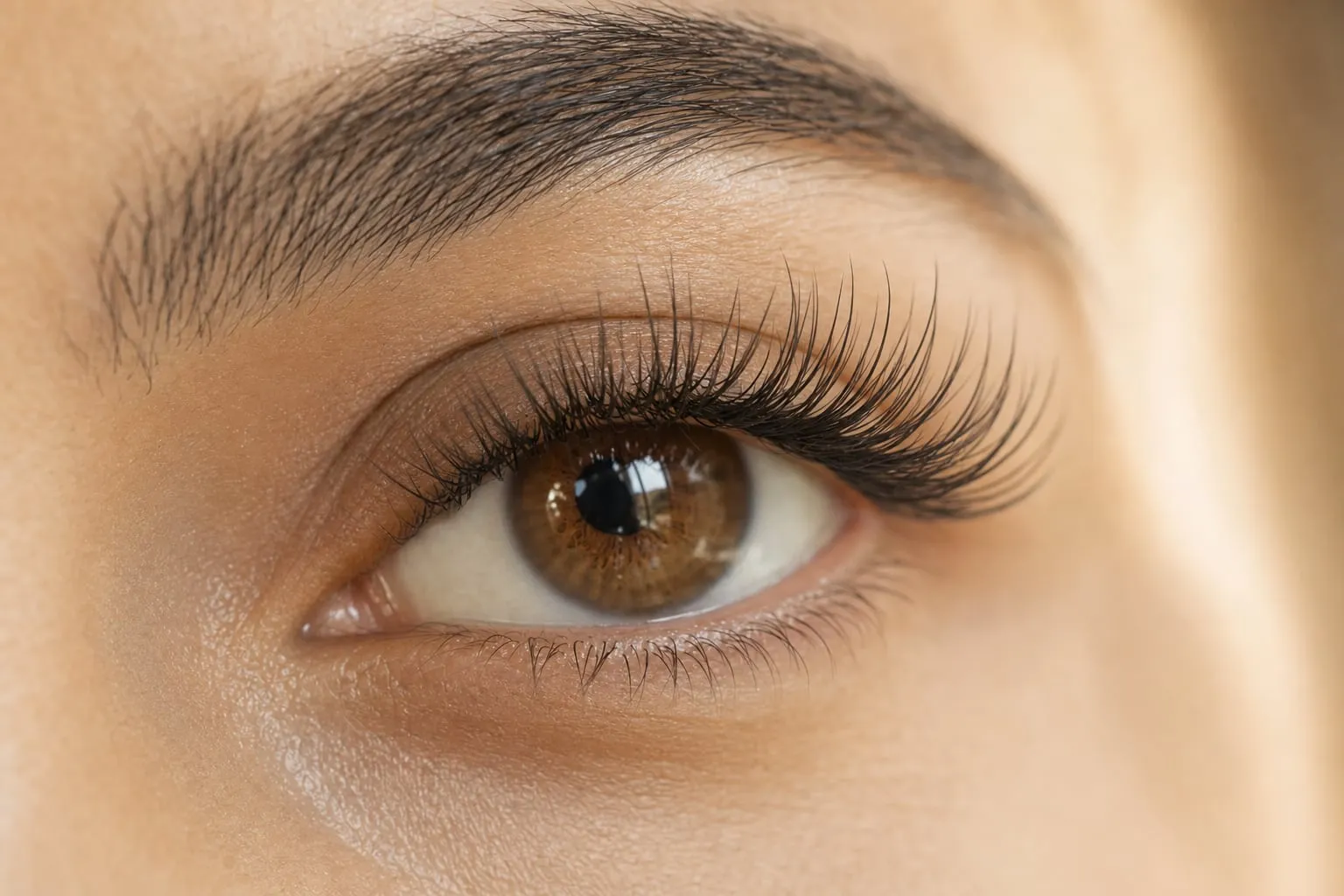
The right lash map puts your longest extensions where your eye needs lift. For round or close-set eyes that means the outer corner (a cat eye), and for almond, downturned or wide-set eyes the center (a doll or open eye). Hooded eyes and monolids need a lifting curl before any style will show. Length follows your natural lashes, which is why two people asking for the same style can leave with different maps.
The short version
- A lash map is the plan for the length and curl of each section of your lash line, drawn before any extension goes on.
- The style is simply where the longest lashes sit: at the outer corner (cat eye), at the center (doll), between the center and the outer third (open eye), or following your own line (natural).
- Your eye shape picks the style; your natural lashes cap the length. Human upper lashes usually don’t grow past 12 mm, so a map far longer than that puts extra strain on each lash.
- Treat any eye-shape chart as a starting point. Your artist should check your lid, your eye angle and your natural lashes in person.
What is lash mapping?
Lash mapping is the plan a lash artist draws before a single extension goes on: a length and a curl for every section of the eye, from inner corner to outer. Many artists sketch it on the under-eye pad, zone by zone. Applying one length straight across is what makes a set look flat or “off”. Mapping is why the same style can look made for you and slightly wrong on the next person.
Mapping isn’t only for volume. A classic, hybrid or volume set all start from a map; the type of set only changes how full each zone looks.
What are the main lash extension styles?
Natural
Subtle- Longest lashes
- Follow your own lash line
- Effect
- Your lashes, but better
- Suits
- Almond eyes, first sets
Open eye
Brightening- Longest lashes
- Center to outer third
- Effect
- Bigger, more awake
- Suits
- Hooded, monolid, most shapes
Cat eye / Fox
Elongating- Longest lashes
- Outer corners
- Effect
- Lifted and elongated
- Suits
- Round and close-set eyes
Doll
Widening- Longest lashes
- Center of the eye
- Effect
- Rounder and wider
- Suits
- Almond, downturned, wide-set
Three variations come up often. A fox eye is a cat eye pushed further, with the length angled up and out even more steeply. A squirrel map peaks just past the center, between a doll and a cat eye. Wispy (also called spike) mixes longer closed spikes through any of these maps for a textured, fluttery finish.
Doll eye vs open eye: what’s the difference?
Both put length in the middle of the eye; the difference is how sharp the peak is. A doll eye peaks right at the center and shortens noticeably toward both corners, so the eye looks rounder. An open eye rises more gradually and peaks between the center and the outer third, so the eye looks bigger and more awake without the doll-like roundness.
If your eyes are already round, an open eye is usually the more flattering of the two. If your eyes are almond-shaped or downturned and you want a clearly rounder look, a doll map does that.
How do you find the right lash map for your eye shape?
Start with three checks in a mirror: the angle of your eye, how much lid shows, and how far apart your eyes are. The first two have clinical terms behind them, which helps when the internet disagrees about what counts as “hooded”.
Your eye angle. In most people, the outer corner sits about 2 mm higher than the inner corner. Ophthalmology references call that a positive canthal tilt; lash artists would call a clearly steeper tilt upturned, and an outer corner lower than the inner one (a negative tilt) reads as downturned.
Your lid. Hooded lids have a fold of skin that covers much of the lid when your eyes are open. When that fold comes from loose, excess skin, doctors call it dermatochalasis. A monolid (single eyelid) is an upper lid with no crease, a common feature in East Asian populations, where published estimates range from 16.9% to 63.9% depending on the population.
Your spacing. If the gap between your eyes is wider than one eye, they are wide-set; if narrower, close-set.
Then use these as starting points:
- Almond: almost every map works. A cat eye plays up the natural lift; a doll or open eye makes the eye look bigger.
- Round: a cat eye or squirrel map elongates. A heavy doll map makes round eyes rounder.
- Hooded: choose the curl first: an L, L+ or M curl lifts the extension clear of the fold, where a softer curl disappears under it. Then add an open-eye or soft cat map with a little extra length in the outer third.
- Monolid: a lifting curl plus length building through the center to outer eye gives visible lift; a gentle curl lies flat against the lid.
- Downturned: a doll or open eye with real lift at the outer corner counters the downward angle so the eye looks bright rather than tired.
- Upturned: already lifted, so a natural or gentle open-eye map keeps them balanced.
- Close-set: a cat eye draws attention outward.
- Wide-set: a doll map keeps the weight toward the center.
A lid that is heavy enough to rest on your lashes, or that has changed recently, is worth showing to an eye doctor before you book; it can be more than a cosmetic question.
How long should your lash extensions be?
As long as your natural lashes can carry, and not much more. The human upper lid has 90 to 160 lashes, and they usually don’t grow beyond 12 mm before shedding. Every extension is bonded to one of those lashes and stays on it until that lash sheds, so the natural lash, not the photo you saved, sets the ceiling.
Longer isn’t automatically prettier, either. In a 2023 study across four ethnic groups, people’s preference for lash length rose and then fell, peaking at roughly one-third of the width of the eye. That is the same proportion researchers measured across 22 mammal species; in wind-tunnel tests on a model eye, lashes that length cut dust deposition and tear evaporation by about half.
The cost of going too long is real. The American Academy of Ophthalmology warns that tugging and pulling can fracture natural lashes and permanently damage the follicle, and the constant pull of extensions can cause traction alopecia, lash loss from the traction of the synthetic lash. Extra length and weight add to that pull. Our guide to lash extension lengths and thickness explains how diameter adds to that weight.
How we map your eyes at Eye Charm
At Eye Charm, a lash studio in Hyde Park, Austin, every appointment starts with a consultation, and the map is drawn there. We spend a few minutes on:
- Your natural lashes: how long and how strong they are. This caps the length and weight of the whole map.
- How your eyes are set: the angle, the lid, the spacing.
- Your day: what you do, and how much you want people to notice.
- The look you want: what you want the set to say, and whether your lashes can carry it.
Length, curl and direction are then chosen per section of your lash line, not from a chart. Sometimes that means recommending a lighter set than the one you asked for, because it will look better and last longer on your lashes. Volume fans are built by hand in the chair to the thickness each lash can carry, and you keep the same artist for your set and your fills, so nobody has to relearn your eyes each visit.
The maps our clients ask for most are cat eye and open eye. If you want to change your style later, say from natural to cat eye, that’s a new set rather than a fill, because a fill follows the map that’s already on your lashes.
Eyelash extension application is a licensed service in Texas; the state’s Eyelash Extension Specialist license requires 320 hours of training. Ana is licensed in Texas and holds 30+ international lash certifications. If this is your first set, what to expect at your first appointment walks through the day itself.
Not sure which map suits you? That’s what the consultation is for. Our eyelash extensions in Austin page covers sets, prices and artists, or you can book your consultation and set and we’ll design the map with you in person.