
extensions
Handmade vs Pre-Made Volume Fans: Which Is Better?
May 30, 2026 · By Anastasiia
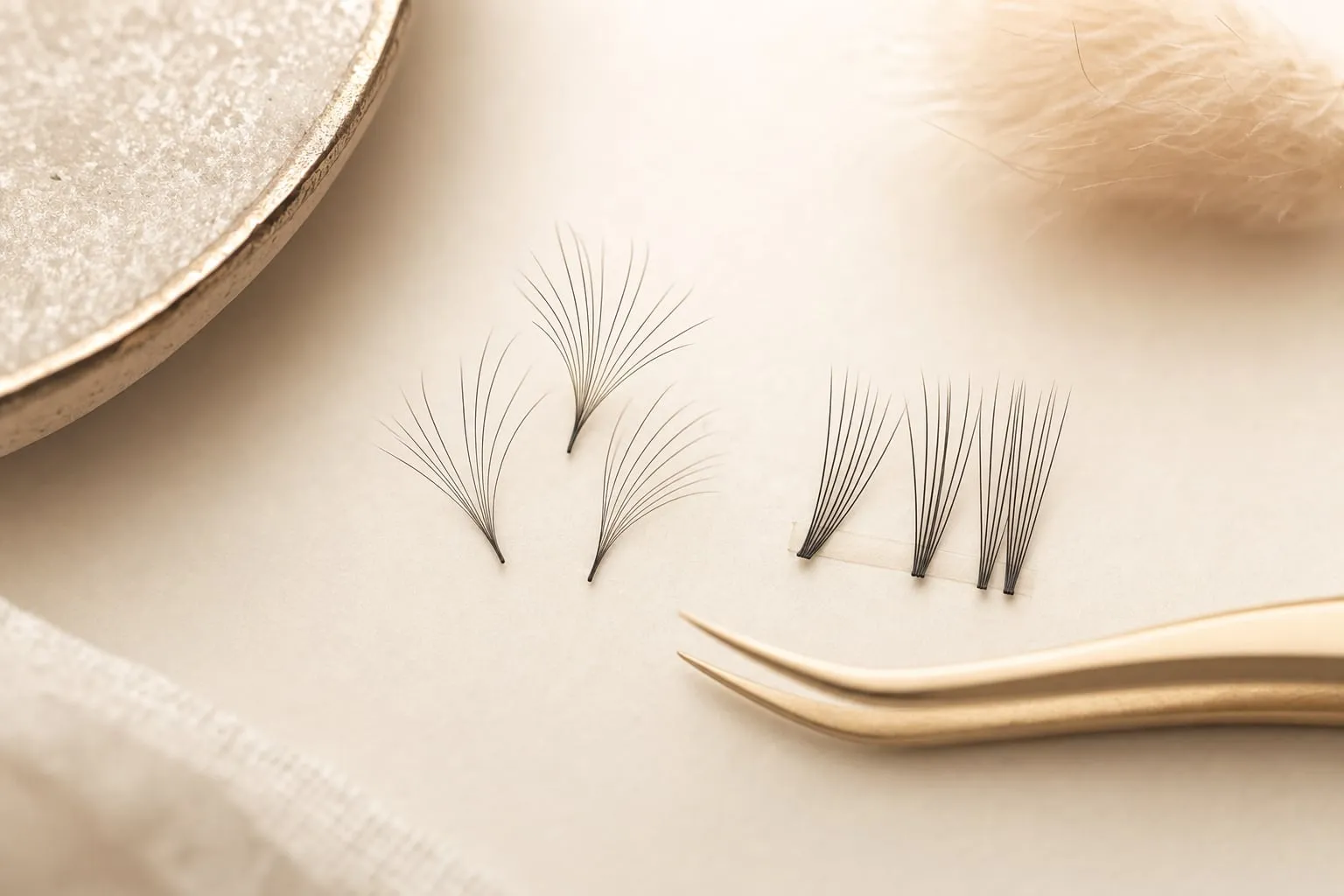
Handmade fans are not automatically safer than pre-made ones. What protects your natural lashes is a light enough fan, placed on one isolated lash. The real difference is fit: a handmade fan is built for the lash it goes on, while a pre-made fan is picked from a tray of identical ones. We make every fan by hand at Eye Charm; here is how the two compare.
The short version
- Pre-made fans are bonded at the base before they reach the studio, either by heat or by glue depending on the brand. Many current ones are heat-sealed and carry no glue in the base.
- Handmade fans are built at the chair. The artist picks up a few ultra-fine fibers, spreads them, and the base is set in adhesive as the fan goes onto one natural lash.
- We found no study comparing the two. A 2024 review of eyelash extension safety notes there is “no published study on the effect of EEs taking into account the size, type and material.”
- For fibers of the same material and length, weight scales with the number of fibers and the square of their diameter. Six fibers of 0.07mm outweigh one thick classic extension, whoever made the fan.
- The trade-off is time. Building every fan by hand takes longer than lifting pre-made fans off a strip.
What is a pre-made lash fan?
A pre-made fan is a volume fan assembled before your appointment: several fine extensions already joined at the base and lined up on a strip, ready for the artist to lift off and attach. There are two kinds. As LashBeePro, a supplier, puts it, “A glue-bonded fan is held together with adhesive. Heat-bonded means the fan is sealed together at the bottom only using heat.”
The bad reputation comes from the glued kind. The same supplier, which stocks only heat-bonded fans, says the glue “adds extra unnecessary weight to the natural lashes.” Another seller of pre-made fans, I AM Lash PRO, says early fans were often “bound together with a thick bulb of dried glue at the base.” So describing every pre-made fan as glued at the base is out of date. Our old version of this page said so, and it was wrong.
What is a handmade volume fan?
A handmade fan is made during your appointment. The artist picks up a few ultra-fine extensions from a strip, spreads them into a fan with tweezers, dips the base in adhesive, and places it on a single isolated natural lash. Nothing holds the fan together until that moment, so its size, spread and number of fibers are decided lash by lash. This is the Russian volume technique; the history and the different styles are in Russian volume lashes in Austin.
Handmade fan
What we use- Made
- By the artist, at the chair
- Base
- Formed in adhesive as it's placed
- Fan size
- Chosen for each natural lash
- Full volume set
- Longer than classic (ours: +65–75 min)
- Consistency
- Depends on the artist's skill
Pre-made fan
- Made
- Before the appointment, on a strip
- Base
- Heat-sealed or glued in advance
- Fan size
- Picked from fixed sizes
- Full volume set
- About as long as classic
- Consistency
- Identical fan to fan
Are pre-made fans bad for your lashes?
Pre-made fans are not bad for your lashes by themselves; overloaded and badly isolated lashes are the problem. Extensions of any kind carry real risks. The American Academy of Ophthalmology lists “trauma to or infection of the eyelid or cornea; allergic reaction to the glue; and permanent or temporary loss of eyelashes.” A 2023 review by the Tear Film & Ocular Surface Society says extensions “have been associated with allergic contact dermatitis, eyelash loss, eyelash base calcification, blepharitis, conjunctivitis, corneal abrasions and keratitis.”
None of that research separates handmade from pre-made fans, and we found no study that does. The 2024 review in the Journal of Clinical Medicine states plainly that there is “no published study on the effect of EEs taking into account the size, type and material,” while warning that “the weight of EEs is having an effect not only on the lash follicles but also on the mechanics of the upper eyelid, especially in high-volume EEs.” On the mechanical risks, pre-made fan sellers and studios that hand-make fans name the same two: weight and isolation. A heavy fan loads a lash whether it came from a tray or from tweezers, and I AM Lash PRO notes that fans bridging two or three lashes “pull as the lashes grow at different rates.” The AAO adds that “rubbing, tugging or pulling can fracture your natural lashes.” More on that in do eyelash extensions damage your natural lashes.
How much does a volume fan weigh?
Weight depends on fiber count and fiber thickness, not on who made the fan. For extensions of the same material and length, weight scales with the cross-section of the fiber, which grows with the square of its diameter. So a 0.15mm fiber is not three times a 0.05mm one but nine times. Set one classic 0.15mm extension at 100%:
One classic 0.15mm
Baseline- Fibers
- 1 × 0.15mm
- Relative weight
- 100%
3-fiber fan of 0.07mm
- Fibers
- 3 × 0.07mm
- Relative weight
- About 65%
6-fiber fan of 0.05mm
- Fibers
- 6 × 0.05mm
- Relative weight
- About 67%
6-fiber fan of 0.07mm
Heavier- Fibers
- 6 × 0.07mm
- Relative weight
- About 131%
“Volume is lighter than classic” is only true when the fibers are fine enough for the count. The figures also leave out the adhesive at the base. Every fan gets the adhesive that attaches it to your lash; a glue-bonded pre-made fan also carries the factory glue that holds it together. A heat-bonded or handmade fan doesn’t. For how diameter and length work across a whole set, see lash extension lengths and thickness.
Why we make every fan by hand
The lashes under the fans differ. An upper lid has 90–160 lashes, and they are not all at the same stage: one study measured a complete eyelash cycle of about 90 days, with roughly 34 of them spent growing. A short, fine new lash can sit next to a mature one (the growth cycle explained). Building each fan at the chair means the artist sets its size for the lash under it, within the 3–6 fibers we use per fan. A tray offers a set of fixed sizes.
The trade-off is time. A volume lash extensions full set at Eye Charm, in Hyde Park, Austin, is booked for 3 hours with Anastasiia or 3 hours 20 minutes with Samantha. A classic set takes 1 hour 45 minutes or 2 hours 15. A volume full set is $220 with Samantha or $300 with Anastasiia, and volume fills are $115 or $150. Every one of those fans is handmade; we don’t use pre-made fans on any set.
How can you tell if your lash artist uses pre-made fans?
Ask, and check the appointment length.
- Ask directly: “Do you make volume fans by hand at the chair, or use pre-made fans?” If a studio hand-makes fans, it’s an easy yes. “We use the highest-quality fans” doesn’t answer the question.
- Compare appointment times. LashBeePro says “a full volume set created with pre-made lashes takes approximately the same amount of time as a full set of classic lashes.” If a studio’s volume and classic sets are booked for the same length, ask about it.
None of these makes a pre-made set dangerous. Whatever the fans, itching, redness, swelling or pain around the eye, or any change in your vision, is a reason to see an eye doctor promptly rather than wait it out. Have the set removed by a professional; don’t pull it off yourself.
If you’re a lash artist choosing between them
The same rules apply from the other side of the tweezers. Choose fans by weight per lash (count times diameter squared), insist on clean isolation, and look for narrow, thin bases if you use pre-made fans at all. Heat-bonded fans skip the factory glue, so they carry less at the base. Pre-made fans give consistency and shorter appointments; handmade fans give fit. Anastasiia trains artists one-on-one in the Hyde Park studio; group and online training are in development, with a waitlist for lash training.
Want volume built fan by fan for your own lashes? See how sets and prices work on our eyelash extensions in Austin page, or book a volume set with either artist.